
Take charge in safeguarding your accounts.
 Use our digital services
 Learn to spot online scams
 Monitor your credit report
Stay Alert and Secure
Criminals are always looking for ways to steal account and personal information. While Michigan First makes significant investments in security resources that defend member accounts, your financial security is also dependent on how you protect yourself.
Safeguard Your Information
Do not share usernames, passwords, security codes, PIN information, full debit or credit card numbers, or CVV codes. Michigan First will never contact you asking for your account number or your social security number. Sharing this information with anyone may compromise your financial security.
Oftentimes, scammers will “spoof” a financial institution's phone number to look legitimate. Scammers will text or call from these numbers pretending to work for the organization in order to retrieve personal and financial information.
If you were not expecting a call or text message from us, please do not respond. Michigan First will never unexpectedly call or text you asking for login credentials, credit card numbers or any other personal information. Do not share this information. Instead, hang up the phone or ignore the text message and call us directly at 800.664.3828.
Monitor Your Accounts
Enroll in Online Banking and download the Michigan First Mobile App to access your bank account from anywhere at any time:
- Turn credit and debits cards on/off when not in use
- Change PIN numbers
- Be alerted anytime an international or online purchase is made
- Set spending limits
- Be alerted anytime a purchase is made above an amount you choose
- Sign up for e-statements to monitor your accounts
Ways To Protect Yourself
Be vigilant in the fight against fraud
You can protect yourself and your accounts by recognizing and preparing for online banking threats. Here are a few ways to keep yourself and your information safe:
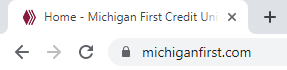
Before you input your username and password, make sure you’re on the authentic MichiganFirst.com. Do this by checking your browser address to see if it has a lock icon and the proper URL, which is https://michiganfirst.com. It should appear similar to below, depending on which internet browser is in use. The following example is using Google Chrome.
If you use our mobile app, you have features at your fingertips to help manage your credit and debit cards and alert you of suspicious activity. Within the mobile app you can:
- Turn credit and debits cards on/off when not in use
- Change PIN numbers
- Be alerted anytime an international or online purchase is made
- Set spending limits
- Be alerted anytime a purchase is made above an amount you choose
You can also quickly and easily sign up for paperless statements, which provides added security over having paper statements mailed to your home.
Phishing is when an impostor attempts to deceive their target into sharing personal information. They may try to impersonate a Michigan First team member through email, phone call, or text, asking you to confirm your information or saying you've won something. It might seem legitimate, but it isn't.
A few examples:
- You receive an email that appears to be from a reputable company you know or do business with. The email asks you to reply or go to a website that looks like MichiganFirst.com, where you’ll be asked to give your username, password, account number, personal identification number (PIN), Social Security number, or other personal information.
- You receive a voicemail or text message telling you your bank account will be closed, frozen, or terminated unless you call or go to a website, where you’ll be asked to give your personal information.
Scammers often try to create a feeling of urgency or alarm by threatening to close off an account or offering a security update—as soon as you provide your personal information. A few more common culprits are emails, phone calls, or text messages that:
- Require you to give personal or account information directly on the email or on a website; some fraudsters use pop-up windows to ask for confidential information.
- Threaten to close or suspend your account if you don’t take immediate action.
- Invite you to answer a survey that asks for personal or account information.
- Say your account has been hacked, then asks for personal or account information.
- Tell you there are unauthorized charges on your account, then ask for personal or account information.
- Ask you to confirm, verify, or update your account or billing information.
- Ask you to provide account information because someone wants to send you money.
- Claim you’re getting a refund.
- Say you’ve won a contest.
Don’t open any email attachment (even if it appears to be from a friend or co-worker) unless you’re expecting it or you’re absolutely sure you know what it contains.
Be cautious of subject lines or emails with a generic message like “check this out” or “thought you’d be interested in this.” Make sure you know who sent the email before you open an attachment or click any links.
Oftentimes, these scams include “spoofing” a financial institution's phone number to look legitimate. Scammers will then text or call from these numbers in order to retrieve personal and financial information.
If you were not expecting a call or text message from us, please do not respond. Michigan First will never unexpectedly call or text you asking for login credentials, credit card numbers, or any other personal information. Do not share this information. Instead, hang up the phone or ignore the text message and call us directly at 800.664.3828.
Install and update the latest browser, anti-virus, and firewall software on your computer.
Be cautious of offers for free anti-virus software. Be sure to purchase your software from a reputable company. Look for anti-virus software that scans incoming communications and files for viruses, removes or quarantines viruses, and updates automatically.
A firewall is software or hardware designed to block unauthorized access to your computer. It’s especially important to have a firewall if you have a cable modem, DSL line, or other broadband connection, because they are targeted often. Many current operating systems come with a built-in firewall, which must be turned on.
While it is our mission to make our products and services secure, there are things you can do to keep your accounts safe, too:
- Don’t give your account numbers or any personal or financial information over the phone unless you initiate the conversation and know the person or organization.
- Don’t give personal information to any stranger, even someone claiming to be from Michigan First.
- Don’t print your driver’s license, phone, or Social Security number on your checks.
- Report lost or stolen checks immediately, and we’ll stop payment on the check numbers you report. When you get new checks, look through them to make sure none of them were stolen in the mail.
- Store your new and canceled checks in a safe place.
- Tell us right away if you receive any suspicious phone inquiries asking for your personal or account information. Also, tell us if you see anything suspicious in your account activity or on your statement.
- To help keep thieves from stealing your identity, destroy or store financial information securely (including bank statements, invoices, ATM receipts, and credit card receipts).
- Guard your PINs and passwords. Don’t store them on your phone or write them on your card.
- Create secure PINs and passwords. Don’t use birth dates, your Social Security number, driver’s license number, address, or any family names. Someone trying to steal your identity may have this information.
- If you use MichiganFirst.com or one of our apps in public or on a shared or public computer, be sure to sign out when you’re finished and delete all cookies.
- Be careful when you use your device in public areas. Look out for anyone who may be watching what you’re doing.
Current & Common Scams
Keep up on the latest scams
Here are a few common fraud schemes recently reported in the news. Unfortunately, new scams surface every day. As a result, this list is always changing. To stay up-to-date, visit the Federal Trade Commission.
Gift cards are popular with scammers because they're easy to find and buy. They also offer increased anonymity for scammers and limited protections for buyers.
What These Scams Look Like
- A scammer assumes the identity of an authority figure representing an agency like the IRS or Social Security Administration. They say you owe back taxes or have to pay a fine and request payment via gift card. They ask for the card number and PIN to complete the payment, which allows them to get the money you loaded onto the card.
- You are approached to deposit a check on someone else's behalf. You are promised a portion and asked to return the remainder via gift cards. A few days later, the check is returned as fraudulent and you are out that money.
What You Need to Know
- Legitimate companies do not request payment via gift cards. Any request to pay via gift card should throw up a red flag and be treated with caution.
- Treat Gift Cards like a Debit or Credit Card. As soon as you provide the gift card number and the PIN, anyone can access the funds contained on the card.
Capitalizing on the confusion and urgency surrounding an emergency situation, scammers pose as a family member or friend in need of urgent financial assistance.
What These Scams Look Like
- A scammer calls you saying that a friend or family member was involved in an accident. They'll stress the urgency of the situation and mention that the friend or family member will be arrested unless a large sum of cash is provided for bond. In many instances, they schedule a follow-up call from an authority figure such as a doctor, lawyer, or police officer to attempt to legitimize the scheme by providing details about the accident.
What You Need to Know
- Resist the pressure to send money immediately. Hang up and contact the friend or family member to check to see if they're really in trouble. If you can't reach the person who is supposed to be in trouble, contact someone else in your circle of friends or family to verify the authenticity of the story.
Romance scams have been on the rise in recent years as dating apps increase in popularity. In this scheme, someone you have never met in person, asks you to send them money via wire transfer so they can travel to meet you or get home to a loved one.
What These Scams Look Like
- You meet someone on a dating app who says they're living or traveling outside of the country. After building a rapport, they ask you to wire funds or purchase gift cards to cover travel expenses or customs fees associated with visiting you.
What You Need to Know
- Never send money, gift cards, or gifts to someone you haven't met.
- Do your research before jumping into a relationship with someone you've met online. Reverse image search profile pictures, investigate job titles, and review social profiles to identify any red flags or inconsistencies.
Promising to settle significant credit card debt or reduce repayment obligations, fraudsters target consumers with challenged credit or significant credit card debt, requesting an up-front fee in exchange for their "services."
What These Scams Look Like
- You receive an offer from a "company" promising to remove negative information from your credit report and improve your score. To render their "services", they request an up-front fee. After the "fee" is paid, the agent breaks contact and disappears with your money.
- A telemarketer contacts you with a pre-negotiated settlement or guaranteeing their ability to reduce your monthly payments only if you can pay a large fee in advance.
What You Need to Know
- Don't pay any money until the company delivers a written offer for a loan modification and you have formally accepted this offer.
- A legitimate agency will provide detailed documentation outlining a settlement or changes to a repayment plan, provide an accounting of fees, and spell out the consequences of a lapse in payment.
Student loan scams have been on the rise in recent years, with scammers attempting to defraud borrowers seeking student loan debt cancellation.
What These Scams Look Like
- You receive an offer from someone claiming to be from the Department of Education or a loan servicer asking you to confirm personal information as a way of gaining access to your accounts. These scammers may even share a "debt relief application" that is actually a direct deposit or Power of Attorney form - which allows them to begin funneling money from your bank account.
- You receive an offer promising special access to help you get your loans forgiven faster, for a fee.
What You Need to Know
- Nobody can guarantee eligibility, provide early or special access, or help you jump the line. Anybody promising to do so is a scammer. This program is completely free — and the only way to apply is at StudentAid.gov.
- Don't share your FSA ID login information. Anybody claiming to need this information to help you, is a scammer.
Promising assistance to desperate homeowners facing foreclosure, scammers request an upfront fee to make changes to your mortgage or peddle phony paperwork to gain ownership of your home.
What These Scams Look Like
- Pretending to be a housing counselor or lawyer, scammers will offer to negotiate with your lender to lower your mortgage payments. They’ll tell you not to contact your lender and may tell you to make mortgage payments directly to them or to transfer your property deed.
- In some instances, scammers will pressure you to sign paperwork to finalize a "new loan". Buried in the stack is a document that gives them the deed to your home in exchange for the loan.
What You Need to Know
- Don't pay any money until the company delivers a written offer for a loan modification and you have formally accepted this offer.
- The company must disclose key information to you. If you decide to accept your lender’s offer, the company must provide a document outlining loan changes, provide accounting of fees, and consequences of a lapse in payment.
- The company’s ads and telemarketing pitches must clearly state that your lender may not agree to change your loan and they are not associated with the government or your lender.
Scammers pose as celebrities or public figures on social media or dating apps to steal money and personal information, often by pretending to start a personal relationship.
What These Scams Look Like
- A scammer will send you a private message claiming to be a celebrity, thanking you for your support or expressing interest in starting a personal relationship. Once trust is established, they may ask for money to cover travel expenses, promote an investment opportunity, or sell you exclusive merchandise. Some even use deepfake technology or cloned voices to add authenticity to phone calls or video chats.
What You Need to Know
- Celebrities and public officials will never personally reach out asking for money.
- Be cautious of high-pressure tactics, requests for unusual payment methods, like gift cards or cryptocurrency, or promises that sound too good to be true.
- Never send money or personal information to anyone you haven’t met in person and never agree to open bank accounts, ship packages, or invest with online acquaintances.
What These Scams Look Like
- A scammer approaches you in public, commonly a parking lot, and asks to borrow your phone to make a quick call or send a text. Once you unlock your device and hand it over, they may quickly access your banking apps, digital wallets, or personal accounts to steal money or information.
- In other cases, they may install malicious software or use your open apps to make unauthorized purchases, send messages, or reset account passwords before returning your device.
What You Need to Know
- Treat your smartphone like the keys to your home or car. Never hand it to a stranger, no matter how urgent or convincing their story may sound.
- Never unlock your device for someone you don't know, even for a quick call or message.
- If someone says they need help, offer to make a call on their behalf instead.
How We Protect You
Top-notch defense against scams and identity theft
Protecting you and your money is our highest priority. We invest a significant amount of resources to ensure your personal information stays secure.
When you sign in with a device we don’t recognize, we’ll ask you for your username, password, and a temporary identification code, which we’ll send you by automated call or text message. Once you input the identification code, you'll be securely signed into your accounts. This multi-step process helps us protect your accounts and allows us to recognize your device the next time you sign in.
As an added layer of protection, Michigan First has also implemented enhanced ID verification, powered by Jumio. If we detect suspicious or high-risk activity, your identity is verified by comparing a quick selfie with your government-issued ID. This added step is highly secure, difficult to fake, and helps protect you from impersonation and account takeover.
We use 128-bit encryption technology to protect your username, password, and other personal account information when you’re using MichiganFirst.com or the Michigan First Mobile App. You’ll know your information is encrypted when the MichiganFirst.com page you’re on starts with “https://” and you see a lock symbol in your web browser.
It should look something like this, with slight differences depending on which web browser you are using. Below is an example from Google Chrome.


